Hot leads & briefs · From $1,750/mo
Who to call this week, and why, on one card.
We watch your institutions for the moments worth a call and research each one properly. Each one lands on a card built to be read in under 30 seconds. Your rep writes the message and sends it.
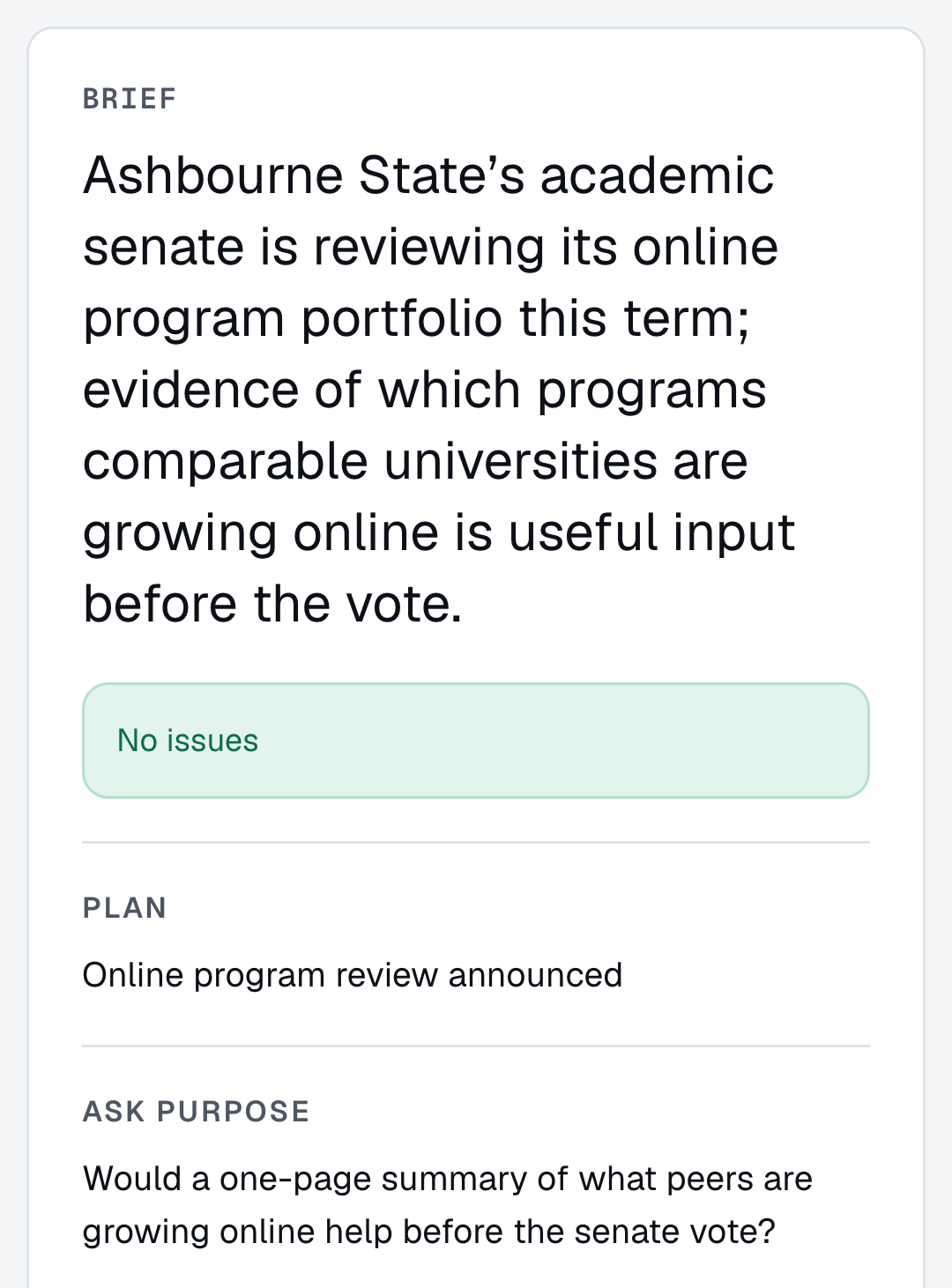
What’s in a brief
Six fields, every time, each with a hard length limit. A card that runs over gets rewritten or held back. It never reaches your rep.
- Why now1 line + source
- The thing that just happened at the institution, with the link to where it happened.
- Who1 line
- Name and title, whether they’re still in the role (with the date we checked, or “unverified”), and any warm path to them.
- Angles2–3, ≤ 15 words each
- Ways in. One is marked recommended, with the reason in 12 words or fewer.
- Talking points≤ 3, ≤ 20 words each
- What’s worth saying, each with a source your rep can open.
- The ask1 line
- What the first message asks for.
- Likely objection1 line
- What they’ll probably say back, and the answer.
Your rep writes the message. Drafts come later, as an add-on, once your reps have reply data.
Where the leads come from
The trigger is something that just happened at the institution: a new online program, a new dean of online learning, a new vice president for enrollment, an accessibility deadline. Each card says whether the person is still in the role, with the source and the date we checked, or marks it unverified. Every talking point carries a source your rep can open. If we can’t source a claim, it stays off the card.
A sample brief
One filled card for a made-up vendor about a real institution. Every fact links to the public page it came from.
- Why now
- UNC Charlotte is introducing new and expanded fully online degree programs and certificates for 2026–2027.
- Who
- Dean of Online Learning, still in role: unverified
- Angles
- Open on the new programs and ask who owns online growth. Recommended: It ties straight to what they announced.
- Offer to help working adults find the right program.
- Talking points
- The ask
- A short call with the dean of online learning.
- Likely objection
- We already have an internal team for online growth.
Written for an online-program services vendor (synthetic).
- NCES College Navigator (IPEDS), n/a (reference page): University of North Carolina at Charlotte — College Navigator
- UNC Charlotte Online, 2026-08-27: UNC Charlotte broadens online learning for 2026-2027 academic year
- UNC Charlotte Online, 2026-08-27: UNC Charlotte broadens online learning for 2026-2027 academic year
- UNC Charlotte Online, 2026-08-27: UNC Charlotte broadens online learning for 2026-2027 academic year
Why your reps write the message
The research is the part that rarely gets done. The writing is the part your reps are good at, and a message in their own words sounds like your rep.
Drafts aren’t part of it yet. Once your reps have a few weeks of replies on the briefs, we can add machine drafts as an add-on, if the replies say they’d help.
Pricing
Starter $1,750 a month for 150 institutions, Core $2,950 a month for 500 institutions, Scale $4,500 a month for 1,500 institutions. Available after a Warm Start. The sprint is where we learn your institutions, your buyers and how your reps like to work, so the weekly briefs start from that. The Warm Start sprint
Start with the sprint.
$7,500 fixed. Warm-path map and briefs in two to three weeks; your universe of up to 500 institutions within 30 days of kickoff. You’ll see about 20 briefs on your own institutions before you decide on the weekly ones.